The Skin
Skin
Skin is classified as an organ and includes hair and nails and nerve endings.
Functions of the skin: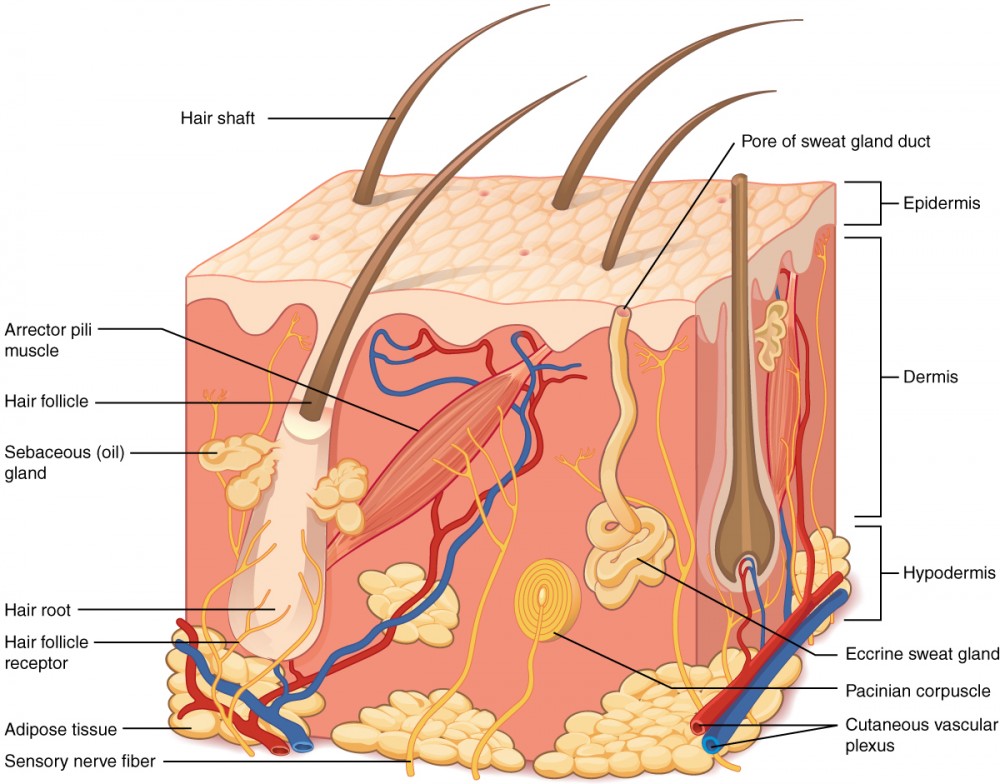
- Protection
- Elasticity
- Maintaining temperature
- Exploration of environment
- Communication
- Absorption / elimination
- Storage
Nerve fibres which transmit the to the touch or tactile responses are larger than those associated with the other senses.
At birth the baby’s skin is covered with a whitish grease called the vernix, which acts as an insulating layer helping to protect the New-born from minor infections and also to cope with changes of temperature. For the naked New-born the temperature at which body heat can be maintained with minimal effort is 32°C. With clothes on, this temperature is 24°C. Temperature control is poorly developed in the early months and babies are at risk of:
1. Overheating because sweat glands do not develop until the third year. Overheating hasbeen linked with cases of Sudden Infant Death Syndrome (SIDS) as the crying babies make to alert parents also increases body temperature; and
2. Chilling also puts babies at risk because they are not able to shiver as a way of raising their body temperature. One of the main mechanisms for temperature control is babies’ development of brown fat layers in the first and second years. A New-born’s skin is thin, but it contains as many nerve
endings as that of the adult, although smaller.
Machanoreceptors:
- Meissner corpuscles are tightly packed together at birth and will only start to thin out as the skin grows. These touch receptors register light touch
and stroking, the main movements in baby massage and yoga. - Pacinian corpuscles recognise and respond to deep pressure.
This ability to ‘feel’ pain protects babies from harm. The forms of touch the child receives can have an effect on future behavioural patterns.
The skin also contains thermoreceptors detecting warmth and cool and nociceptrors which detect pain and overlap with the pacinian corpuscles.
Skin to Skin:
Direct skin-to-skin contact has been shown to produce amazing physiological changes:
- Temperature fluctuations are reduced. Babies maintain their temperature from the warmth of their mothers skin
- Babies become calmer and cry less
- Using this form of holding encourages and maintains the ability of a preterm baby to breastfeed.
- The risk of apnoea (arrested breathing) and sudden changes in heart beat are reduced.
 The human homunculus showing the extent of sensory cortex that is devoted to each body part. The area that responds to touch is proportionally more developed. The lips are highly sensitive in a baby, followed by the thumb and the hand. This also matches to sensitivity.
Why do we need to know?
The use of touch during massage and yoga has profound implications for babies. It excites the Meissner corpusles, relaxing the baby and teaching correct responses to touch. As children grow and their understanding of their bodies improves they can start to see connections in how pressure on certain parts of the body feels. For example, how we shift our body weight during a three legged down dog and we can feel pressure down one side of our body, most notably in the hand. This is important for children to understand yoga as they get older and make the connection between their physical and mental state. We use poses such as mountain pose to promote a sense of grounding and belonging. This is done through the touch of the feet on the floor.