Reflexes
Reflexes are an important aspect of infant development as mechanisms that assist early functions while more integrated structures replace them. The transition from reflex to voluntary activity is a major process that takes place over the first year with a particularly intense period when babies start becoming mobile.
Primitive reflexes are innate patterns of behaviour. All babies are ‘wired up’ with primitive responses required
for birth:
- Rooting reflex, stroking a baby’s cheek causes a baby to turn the head in the direction of the touch and open a wide mouth
- Moro reflex causes a baby to throw the arms outwards and then bring them back in again
- Sucking reflex
- Blinking reflex
Overcoming gravity is one of the first challenges babies experience. At first, primitive reflexes help maintain infants’ posture while neurological maturation takes place. Over time, postural control and stability become progressively more voluntary and the primitive reflexes become suppressed, allowing new movements to develop. Some primitive reflexes, like the startle reflex, remain with us in adulthood.
Reflexes associated with hands and feet:
- Palmar Reflex –enables babies to have a very strong grip, bending the fingers toward the palm of the hand (up to 4 months). The grasp of a
newborn baby is so strong that her whole body can hang in midair with her bent fingers supporting her weight. The Palmar reflex vanishes to be replaced by voluntary grasping after 5-6 months. - Plantar Reflex – curling of the toes up (birth to 6 months)
- Babinski Reflex – curling of the toes down (3-12 months). It is responsible for the extension of the toes towards crawling. It also inhibits the Plantar
Reflex.
Reflexes to help with movement:
- Walking reflex – if a baby is held with its feet touching the ground, and moved forwards, she will perform walking movements.
- Stepping reflex – if a baby is held with the front of one leg in contact with an object, it will raise its other leg as if to step onto the object.
- Swimming amphibian reflex – if a baby is immersed in water swimming movement can appear spontaneously in the form of breaststroke kicks. These reflexes normally disappear before 6 months.
Postural reflexes help maintain or regain balance:

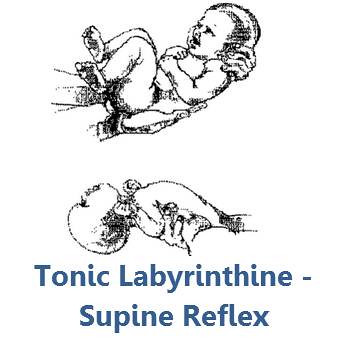


- Tonic Labyrinthine Supine Reflex – Helps develop muscle tone. It is the basis for head control, balance and posture.
- Aysmmetrical Tonic Neck Reflex – Until 4-6 months. This reflex facilitates the birth process, assists breathing and develops homo-lateral movement (same leg same arm movement).
- Symmetrical Tonic Neck Reflex – This reflex is present at birth and reappears just before the baby learns to crawl at 6-9 months. It assists crawling and prepares the baby for upright positions.
- Spinal Gallant Reflex – causes flexion of one hip and extension of the other side of the body. In a spinal prone position if a baby is stroked down one side of the spine the body will curve towards that side. Until 46 months. This reflex assists the birthing process and stimulates movement in the lumbar region. It is connected to the urinary and intestinal functions.
- Head Righting: – brings a baby up to an upright position, assisting with sitting (appears at 5/6 months).
- Segmental Rolling
- Body righting
- Crawling and Walking
Why do we need to know?
To conclude the lesson on the nervous system the following elaborates on why we need to know everything we have covered in the previous topics. Yoga and massage have been shown to speed up myelinisation. Relaxation of parents can help babies to access parasympathetic mode as the parent and the baby’s heart beat and breathing regulate each other.
The use of both diagonal and symmetrical stretches in class supports brain development and development of the neural pathways and to shed their primitive reflexes. The same is also true as children grow, by continuing to use diagonal stretches within classes we are supporting brain development, and using both sides of the brain. By doing stretches such as rocket arms (taking both arms above a baby’s head) we are encouraging them to lose their physiological flexion. This is when a baby will keep the arms bent and close to the body, just as they did in the womb. By encouraging them to lose this we are supporting babies development. We are providing babies and children with the opportunity to express the stage of development they are currently at.
.