Skeletal System
[trustist-reviewer widget=”TR”]
 The skeleton has many functions:
- Support
- Protection
- Assistance of movement
- Mineral storage and release
- Red blood cell production
- Storing energy
There are two types of bone; compact which is dense and solid and spongy which contains open spaces. The proportion of these differs depending on the bone type. A baby’s skeleton consists mainly of cartilage, which hardens into bone during pregnancy in some parts by a process called ossification. The calcium that a baby receives from her mother’s milk after birth is crucial in aiding this process to continue. It is only as the cartilage hardens into bone that babies are gradually able to control their movements. Ossification is completed in adolescence only. Babies have over 300 bones at birth, some of which fuse to form 206 bones in an adult skeleton. This happens in two main parts:
1. the central or axial skeleton (skull,middle hear, hyoid bone in throat, spine and ribcage)
2. The limb or appendicular skeleton (shoulder girdle, arms and hands, pelvic girdle, legs and feet)
Growth of bones is in width, density and length.
- Diaphysis – strength and support
- Epiphysis – Site of growth and attachment of muscle and joint
- Cartilage – smooth surface for articulation and protection from wear
Made up of:
- 50% mineral salts (calcium and phosphorous),
- 25% water,
- 25% protein fibres
The skull of a baby is much larger in relation to the body than that of an adult, amounting to approximately 25% of the total length of a baby’s body at birth. 45 bony elements of the new born skull become fused with 22 skull bones in adulthood. The skull bones in a baby’s head are thin and the facial bones are small. The facial sinuses do not reach the same size as an adult until the age of 10/12 years.
 At birth, a baby’s skull is soft and pliable to be able to pass through the mother’s pelvis. In addition to their pliability, skull bones are divided up in several separate plates that can overlap slightly during birth. In the first couple of weeks after birth, the skull plates re-arrange themselves. This is helped by the action of the jaws during feeding, particularly the stronger sucking required by breastfeeding.The skull bones are not fully fused at birth which allows for the rapid growth
of the brain during the first year. The openings found on the front and towards the back of the skull are called fontanelles; while the smaller posterior fontanelle is closed six weeks after birth, the anterior is only closed by the age of 18 months. The bones of the skull are fully connected with suture like connections by the age of two to three years, creating a ‘crash helmet’ structure.
Joints
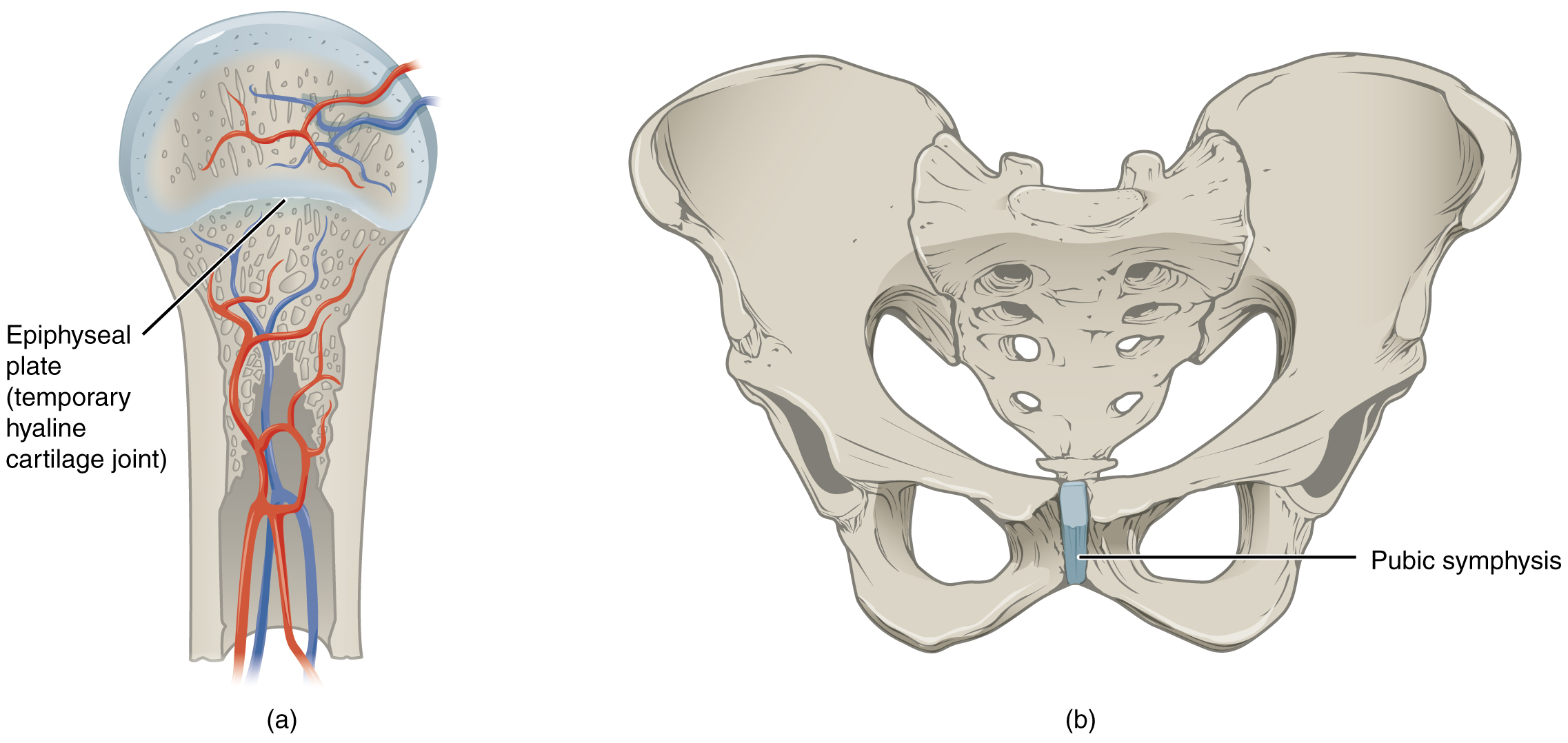 There are 230 joints in the human body. Some are fixed and allow no movement but the majority are concerned with altering the body’s posture. In a New-born joints cannot operate efficiently because the body systems that use them (skeleton-muscular system and nervous system) are not strongly developed. By a toddler’s second birthday however all joints work effectively.
Fibrous joints: connect bones without allowing any movement: in babies’ skulls and pelvic girdles, and also at the base of the spine as bones fuse as part of the growing process.
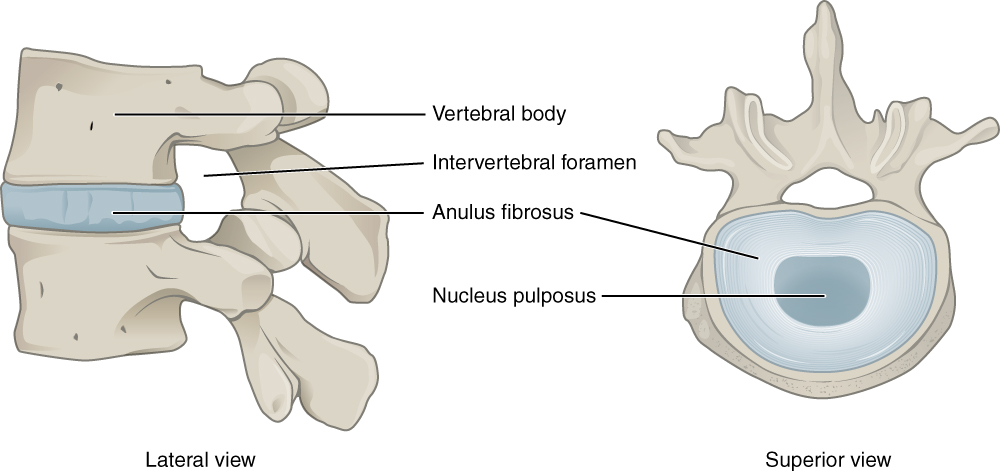
Cartilaginous joints: join bones together with cartilage, allowing very little movement (ribs, vertebrae).
Synovial joints: bones are capped with cartilage, providing a buffer between the two hard surfaces. As an additional aid a protective membrane secretes a synovial fluid which lubricates all the moving parts of the joint. There are seven different types of synovial joints:
- Ball and socket joint (a baby has four of these, two at the shoulders and two at the hips. The shoulder socket is shallower than the hip socket, allowing more movement but with more risk of dislocation)
- Ellipsoid joint (similar to ball and socket but with less range of movement allowing flexion, extension and side to side
 movements. Babies develop ellipsoid joints in wrists and fingers as bones develop from early cartilage)
 - Saddle joint (one concave bone-ending fits into another concavity, allowing movement back and forth and up and down, such as the ankle and the base of the thumb)
- Hinge joint (allowing only basic bending in one plane of action such as extension and flexion up and down or back and forth, such as the elbow)
- Condylar joint (allows rotation besides basic bending, such as the knee, which has also small fluid sacks called bursae that act as shock absorbers for extra protection)
- Plane joint (bones slide past one another when movement occurs but this type of joint allows very little movement as in the toes)
- Pivot joint (allows rotation around an axis as in the neck with the atlas and axis bones permit the rotation of the head. In the forearms the radius and the ulna also twist around each other).

At 3 to 4 months, the cervical curve develops as the head comes upright. At 8 to 9 months, the thoracic curve appears. At 12-15 months, the lumbar curve is developed. Babies have a high and forward centre of gravity with a wide stance and exaggerated lumbar curve to keep the upper body upright. At birth the head is twice as large proportionally and the circumference is the same as the chest. The lower limbs are 15% of body weight compared to 30% in adults.
The bones and joints of the body support the body structure and maintain posture. Over the first two years of life: a) the long bones in the body (legs and arms) grow by means of growth plates in which cartilage cells divide and increase in number and then ossification takes place. b) Wrists (carpal bones) and ankles (tarsal bones) develop more slowly from cartilage. Babies’ ossified kneecaps only develop in the third year or later.
How this relates to us..
Explaining the pressure to be used during yoga and massage is extremely important (meaningful touch but not too hard) and to work to baby’s resistance as ossification is still taking place, bones are fusing and joints are delicate.